
“O Mary, go and call the cattle home,
And call the cattle home,
And call the cattle home,
Across the sands of Dee.”
The western wind was wild and dark with foam,
And all alone went she.
The western tide crept up along the sand,
And o’er and o’er the sand,
And round and round the sand,
As far as eye could see.
The rolling mist came down and hid the land;
And never home came she.
“Oh! is it weed, or fish, or floating hair,—
A tress of golden hair,
A drownèd maiden’s hair,
Above the nets at sea?”
They rowed her in across the rolling foam,
The cruel crawling foam,
The cruel hungry foam,
To her grave beside the sea.
But still the boatmen hear her call the cattle home
Across the sands of Dee.
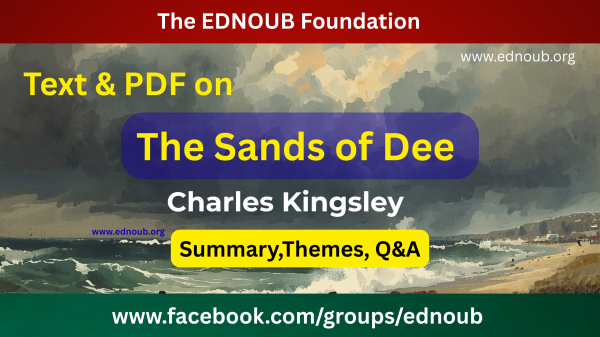
Mary was asked to bring the cattle home across the sands of Dee. The weather became stormy and dangerous. The sea tide slowly rose and thick mist covered the area. Mary lost her way and drowned in the sea. Later, fishermen found her dead body. Even after her death, the boatmen seem to hear her voice calling the cattle home across the sands of Dee.

The poem tells the tragic story of a young girl named Mary. One evening she went alone across the sands of Dee to bring the cattle home. At that time, the weather became rough with strong wind, rising tide, and rolling mist. Nature became dangerous and Mary could not return home. Later, people found her dead body floating near the sea. The poem ends with a mysterious feeling because the boatmen still imagine hearing Mary’s voice. The poem mainly shows the destructive power of nature and the sadness of death.
1. Power of Nature
Nature is shown as powerful and destructive. The sea, wind, and mist together destroy Mary’s life.
2. Death and Tragedy
Mary’s death creates deep sorrow and tragedy throughout the poem.
3. Loneliness
Mary went alone across the sands. Her loneliness increases the sadness of the poem.
4. Mystery and Supernatural Feeling
Even after Mary’s death, the boatmen hear her voice. This creates a mysterious atmosphere.

1. Sands of Dee
The sands symbolize danger, uncertainty, and death.
2. Sea / Foam
The sea symbolizes the cruel and destructive power of nature.
3. Mist
The mist symbolizes confusion, fear, and approaching death.
4. Mary
Mary symbolizes innocence and helplessness.
1. Repetition
“And call the cattle home” is repeated several times to create rhythm and emphasis.
2. Personification
“The cruel hungry foam” gives human qualities to the sea foam.
3. Imagery
The poet creates vivid pictures of sea, wind, mist, and waves.
4. Alliteration
“Cruel crawling foam” is an example of alliteration.
5. Metaphor
The sea is presented as a cruel destroyer.
1. Who wrote the poem?
Ans. Charles Kingsley wrote the poem.
2. Who is the main character of the poem?
Ans. Mary is the main character.
3. What was Mary asked to do?
Ans. She was asked to call the cattle home.
4. Where did Mary go?
Ans. She went across the sands of Dee.
5. What was the weather like?
Ans. The weather was wild and stormy.
6. What hid the land?
Ans. The rolling mist hid the land.
7. Why could Mary not return home?
Ans. She drowned in the sea.
8. What does the sea symbolize?
Ans. The sea symbolizes danger and destruction.
9. What is the mood of the poem?
Ans. The mood is sad and tragic.
10. What kind of poem is it?
Ans. It is a narrative poem.
11. What does “foam” refer to?
Ans. It refers to the white waves of the sea.
12. Why is the poem tragic?
Ans. Because Mary dies in the sea.
13. What is the central theme of the poem?
Ans. The destructive power of nature.
14. What does the mist symbolize?
Ans. It symbolizes confusion and death.
15. What happened at the end of the poem?
Ans. Mary’s dead body was brought back.
16. Who heard Mary’s voice?
Ans. The boatmen heard her voice.
17. What line is repeated in the poem?
Ans. “Call the cattle home” is repeated.
18. What is the tone of the poem?
Ans. The tone is sorrowful.
19. What does “all alone went she” mean?
Ans. It means Mary went alone.
20. What literary device is used in “cruel hungry foam”?
Ans. Personification is used here.
21. Why did Mary become helpless?
Ans. Because nature became violent and dangerous.
22. What lesson does the poem teach us?
Ans. Nature can be powerful and destructive.
23. What is the setting of the poem?
Ans. The setting is near the sea and sands of Dee.
24. Why is Mary remembered?
Ans. She is remembered because of her tragic death.
25. What creates mystery in the poem?
Ans. The boatmen hearing Mary’s voice creates mystery.
26. What does the wind represent?
Ans. The wind represents danger and fear.
27. What kind of atmosphere is created in the poem?
Ans. A gloomy and fearful atmosphere is created.
28. What is the meaning of “drownèd maiden”?
Ans. It means a girl who drowned in water.
29. What happened to Mary’s body?
Ans. Her body was rowed back to shore.
30. Why did Mary go across the sands of Dee?
Ans. Mary went across the sands of Dee to bring the cattle home.
“The Sands of Dee” is a tragic narrative poem. It presents the sorrowful story of Mary, who loses her life in the sea while bringing cattle home. The poet beautifully describes nature through wind, mist, and waves. The poem teaches that nature can sometimes become cruel and destructive. Its emotional tone, repetition, and imagery make the poem memorable and touching for readers.












Leave a Reply